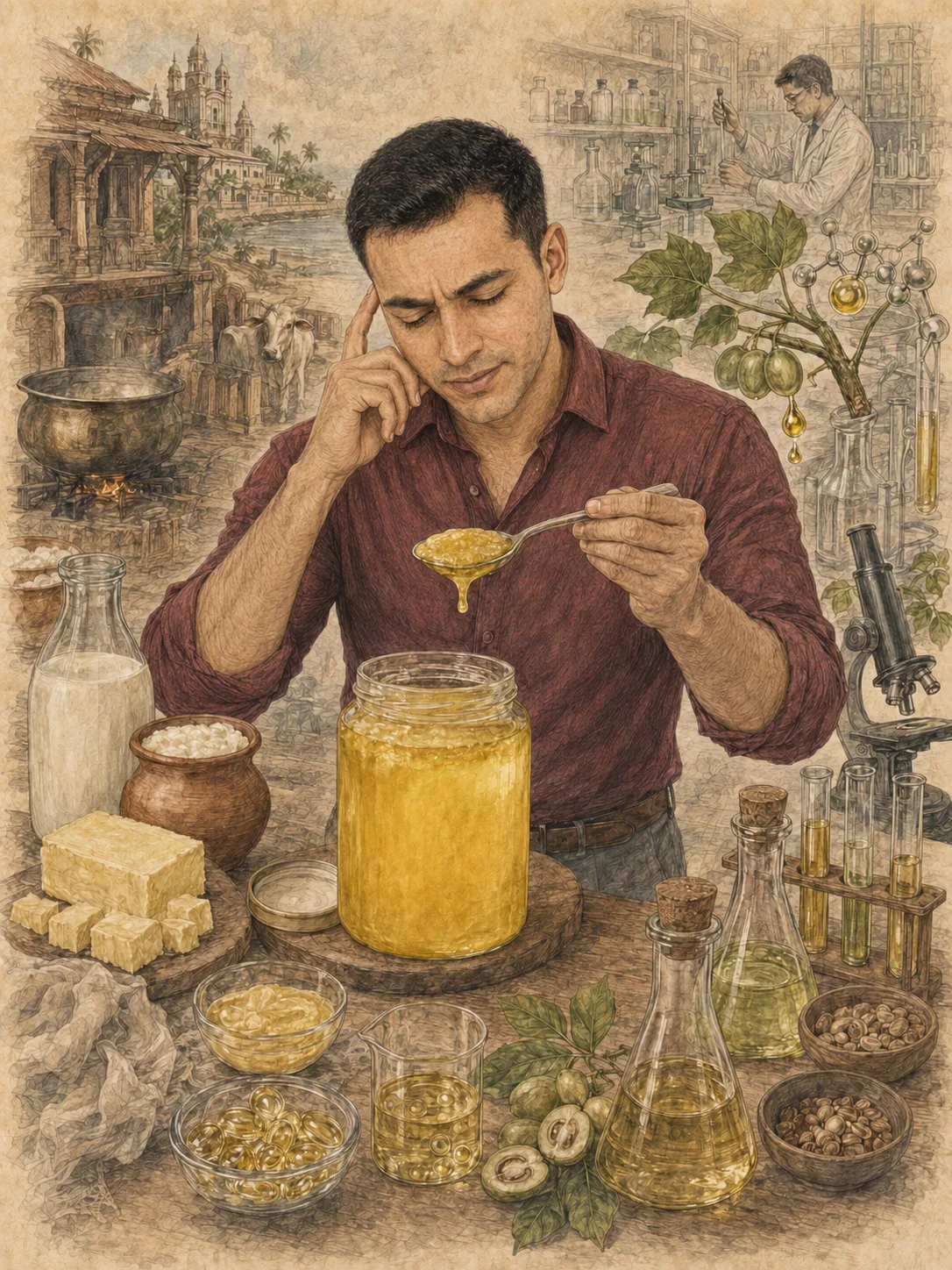
The FSSAI ghee adulteration case concerns SDP Industries in Daman. Tests on multiple ghee samples detected beta-sitosterol, a plant sterol that should be absent, and a fatty-acid profile indicating possible foreign or vegetable fats.
FSSAI prohibited the sale of every ghee variant manufactured, stored or sold by the company from its authorised premises until further orders. The action covered brands including Shraddha, Shree Saras and Gokul.
This was not one suspicious spoonful. The regulator cited repeated non-compliance, earlier samples and referral laboratory confirmation.
Clarified butter became surprisingly unclear.
What is beta-sitosterol doing in ghee?
Beta-sitosterol is a plant sterol. Its presence in ghee is used as evidence that vegetable or other foreign fat may be present in what should be milk fat.
Does this mean all ghee is fake?
No. The prohibition applies to products from one manufacturer and its authorised premises. It does not condemn the entire ghee aisle.
How can consumers reduce the risk?
Buy sealed products from traceable sellers, verify the FSSAI licence and be suspicious of prices that make dairy economics look fictional. Home tests can suggest a problem, but a laboratory establishes it.
The FSSAI ghee adulteration case concerns SDP Industries in Daman. Tests on multiple ghee samples detected beta-sitosterol, a plant sterol that should be absent, and a fatty-acid profile indicating possible foreign or vegetable fats.
FSSAI prohibited the sale of every ghee variant manufactured, stored or sold by the company from its authorised premises until further orders. The action covered brands including Shraddha, Shree Saras and Gokul.
This was not one suspicious spoonful. The regulator cited repeated non-compliance, earlier samples and referral laboratory confirmation.
Clarified butter became surprisingly unclear.
What exactly did FSSAI prohibit?
According to the official government release, FSSAI prohibited with immediate effect the sale of all ghee variants manufactured, stored or sold by SDP Industries from its authorised premises in Ringanwada, Daman. The restriction remains in place until further orders and is not limited to one brand, batch or product name.
The products named as examples included Shraddha, Shree Saras and Gokul. The scope was broad because the authority said the problem appeared across samples, periods and variants.
Whole Meal
Ghee is sold as purity you can smell.
It carries kitchens, festivals, grandmothers and a thousand confident reels about adding one spoon to absolutely everything. That emotional history also makes it a particularly attractive target for adulteration. Milk fat is expensive. Vegetable fat is cheaper. The difference becomes margin if the buyer cannot see it.
The useful part of this story is not another dramatic “everything is poison” video. It is that regulators sampled the product, allowed the manufacturer to appeal, sent the appealed samples to a referral laboratory and acted after the non-conformity was confirmed.
That is what evidence is supposed to look like. Less suspenseful music. More paperwork.
What is beta-sitosterol in ghee?
Beta-sitosterol is a sterol found in plants. FSSAI's ghee standard requires it to be absent. Detecting beta-sitosterol in ghee therefore points toward the presence of vegetable or other foreign fat in a product that should be milk fat.
The laboratory also found a non-compliant fatty-acid composition. A ghee purity test does not rely on one dramatic molecule alone. Analysts compare multiple characteristics because fats leave patterns.
The official release says earlier samples from 2024 and January 2026 had also failed parameters including beta-sitosterol, fatty-acid profile, B.R. reading, R.M. value, saponification value and Polenske value. You do not need to memorise those before breakfast. The important point is that the evidence extended beyond one result.
Does beta-sitosterol make the ghee poisonous?
That is not the most accurate way to describe this case. Beta-sitosterol itself occurs naturally in many plant foods. Its significance here is as a marker of composition. If a product sold as ghee contains evidence of vegetable fat, it may not be what the label says it is.
The scandal is substitution, standard failure and consumer deception. Avoid turning a lab marker into a horror-movie villain simply because its name sounds expensive.
Was the decision based on one batch?
No. The May 2026 inspection produced multiple non-compliant samples. The manufacturer exercised its right to appeal, and referral laboratory reports received in August confirmed non-conformity. The regulator also referred to prior enforcement findings and adjudication.
That repeated pattern is why the order covers every variant from the authorised premises instead of one isolated lot.
Does this mean all ghee in India is fake?
No. This is the sentence most viral posts will misplace somewhere after the eighth alarm emoji.
The SDP Industries ghee ban applies to a specific manufacturer and site. It does not prove that every brand, local dairy or homemade jar is adulterated. It does show why traceability and enforcement matter in a category where consumers cannot reliably identify composition by colour, aroma or grain alone.
Can you test ghee purity at home?
Home demonstrations involving refrigeration, melting, iodine or palm tests may reveal obvious differences, but they are not equivalent to accredited laboratory analysis. Temperature, feed, processing and storage can change texture and colour.
A home test can raise a question. A validated method answers it.
What should consumers do?
- Buy sealed ghee from a traceable retailer.
- Check the manufacturer, batch details and licence number.
- Use FSSAI's licence verification service when something looks wrong.
- Be cautious when the price is implausibly below the cost of dairy fat.
- Report suspect products instead of treating a viral home test as a final verdict.
The technical standards sit within FSSAI's food product regulations. Those standards are less glamorous than packaging, but they are the part that decides whether the jar is actually allowed to call itself ghee.
What is the bigger lesson?
Food fraud often works by borrowing trust from a familiar name. The same gap between presentation and composition appeared in the Ferrero Rocher ingredient story. It also explains why FSSAI is challenging absolute packaging claims and why Karnataka is scrutinising analogue paneer.
The label said clarified butter. The evidence needed clarification.
(-‸ლ)