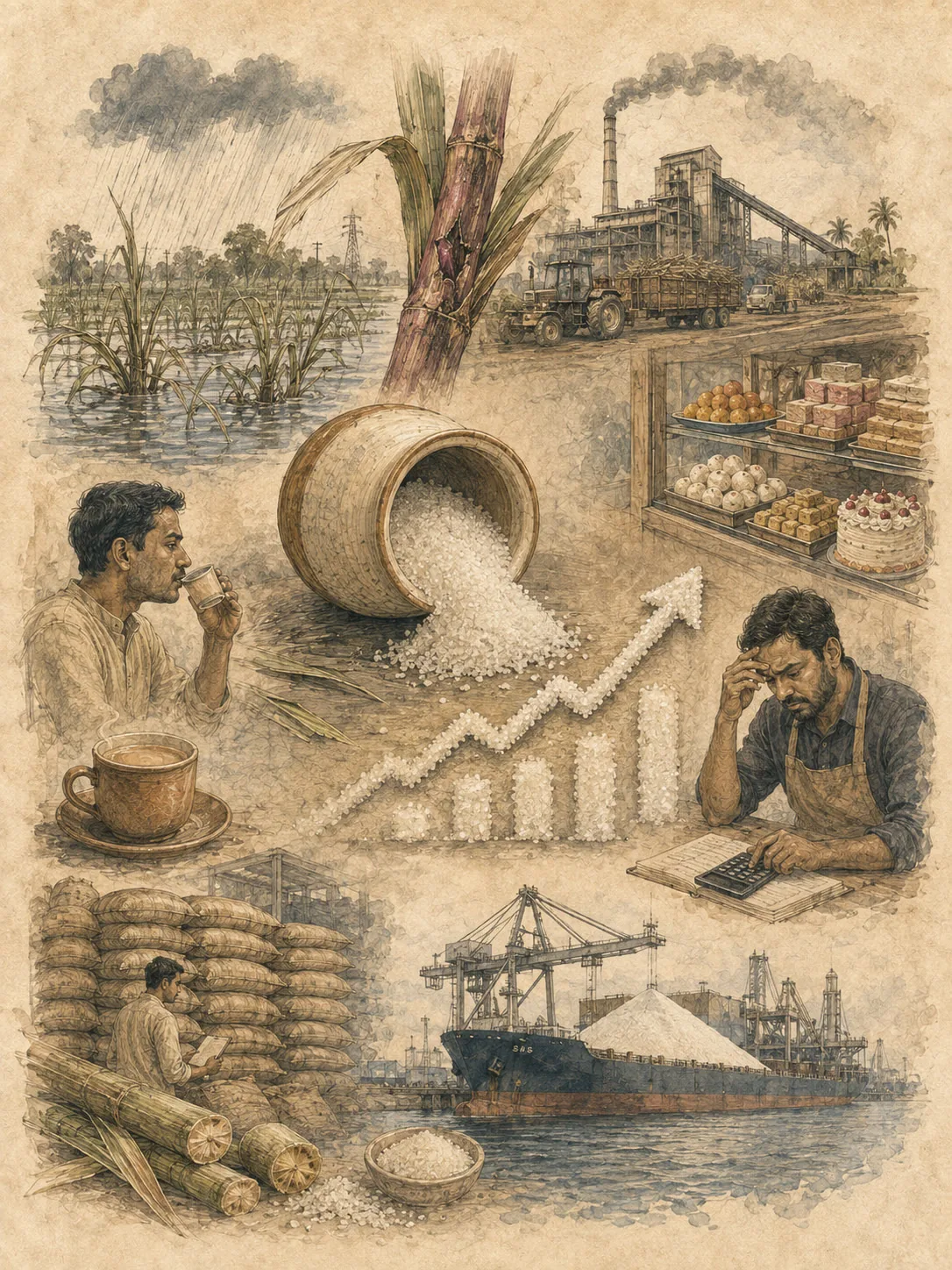
India’s retail sugar price rose from ₹48.18 per kg on 20 July 2026 to ₹55.70 on 20 August 2026. That is roughly 16 percent in one month. The India sugar price rise of 2026 is not one dramatic national sugar shortage. Lower production, weather and crop damage, festive season sugar demand, tighter global supplies, speculation and hoarding all arrived together.
The government says India has enough sugar until the new crushing season begins. It has announced stock limits, tighter reporting, earlier crushing and duty free imports to cool the market.
So no, India has not run out of sugar.
We have simply managed to make tea more financially interesting.
( ˶°ㅁ°) !!
Why are sugar prices rising in India?
Production for the 2025 to 2026 season is expected to be about 306 lakh metric tonnes, below the original estimate of 343 lakh metric tonnes. Excess rainfall, waterlogging, red rot and top borer disease damaged cane. Festival demand then rose while global sugar supplies tightened.
Speculative buying and excessive stocking added more pressure. That is how a supply problem becomes a psychology problem.
Is there an India sugar shortage?
Industry representatives say there is enough stock to meet domestic demand. This is a tight market, not an empty cupboard. Panic buying can help manufacture the shortage people are worried about.
Please do not become a sugar dragon sitting on a 40 kilo crystal hoard.
Who feels rising sugar prices and restaurant food costs first?
Households notice the price on one packet. Bakeries, sweet shops, cafés, beverage makers and restaurants feel it across hundreds or thousands of kilos. Smaller food businesses have less purchasing power and less room to absorb a sudden increase in restaurant food costs.
The sensible response is to audit recipes, reduce waste, test gradual reductions where taste allows and explain unavoidable price changes honestly. That is the same operational discipline behind a good restaurant marketing decision: understand what the customer values before reacting.
Are sugar alternatives actually better?
Do not panic buy. Compare unit prices, choose whole fruit more often than juice or syrup and gradually reduce how much sweetness you expect. Jaggery, honey and date syrup may change the flavour, but they are not magical sugar alternatives.
The country is not out of sugar. It is briefly overpaying for it.
Less sweet. Quite instructive.
( ᵔ ᵕ ᵔ )
India’s retail sugar price rose from ₹48.18 per kg on 20 July 2026 to ₹55.70 on 20 August 2026. That is roughly 16 percent in one month, and market prices climbed even more sharply in some places.
The causes are not one dramatic national sugar shortage. They are a rather annoying cocktail of lower production, weather and crop damage, festive season sugar demand, tighter global supplies, speculation and hoarding.
The Indian government says the country has enough sugar until the new crushing season begins. It has also announced stock limits, tighter reporting, earlier crushing and duty free imports to cool the market.
So no, India has not run out of sugar.
We have simply managed to make tea more financially interesting.
( ˶°ㅁ°) !!
Who put sugar on hard mode?
The first problem is supply.
India’s sugar production for the 2025 to 2026 season is now expected to be about 306 lakh metric tonnes, below the original estimate of 343 lakh metric tonnes. Excess rainfall and waterlogging damaged cane in parts of the country. Red rot and top borer disease also affected crops.
The second problem is timing.
Sugar demand usually rises during India’s festival season. Mithai shops, bakeries, restaurants, beverage makers and households all begin buying more at roughly the same moment. A smaller crop meeting a seasonal demand surge is not an especially mysterious recipe for higher prices.
Then the international market joined the party. The government says global sugar prices rose from about $474 per tonne on 30 June to $552 on 20 August, while the world market is expected to face a deficit during 2026 to 2027.
Finally, there is behaviour. Industry representatives and the government have pointed to speculative buying, excessive stocking and the creation of an artificial sense of scarcity.
That is how a supply problem becomes a psychology problem.
Is India actually running out of sugar?
Apparently not.
The Indian Sugar and Bio Energy Manufacturers Association said there was enough stock to meet domestic demand. India entered the current marketing year with fewer opening stocks than the year before, but this is a tight market, not an empty cupboard.
That distinction matters. If people hear shortage and begin panic buying, they can help manufacture the very shortage they are worried about.
Please do not become a sugar dragon sitting on a 40 kilo crystal hoard.
What about ethanol?
Ethanol is the obvious suspect because India uses sugar sector feedstocks to produce fuel. It is also a slightly too convenient answer.
According to the government, the proportion of sugar diverted to ethanol has fallen from around 12 percent in 2022 to 2023 to 9 percent in 2025 to 2026. Nearly three quarters of ethanol now comes from grain based feedstocks.
That does not mean ethanol policy can never affect sugar markets. It means the evidence does not support blaming this particular price spike mainly on ethanol.
Sometimes the boring answer is the correct one: a weaker crop, strong seasonal demand, global pressure and a little speculative mischief.
Who feels rising sugar prices and restaurant food costs first?
Households notice the price on a one kilo packet. Food businesses feel it across hundreds or thousands of kilos.
A bakery cannot simply stop buying sugar. Neither can a sweet shop, café, beverage company, ice cream maker or packaged food business. When a core ingredient rises quickly, these businesses can absorb the cost, raise prices, reduce portions or change the recipe and hope nobody starts a family WhatsApp investigation.
Smaller businesses are usually more exposed because they have less purchasing power, fewer hedging options and less cash available to absorb a sudden increase.
Consumers may also see the increase spread beyond packets of sugar into sweets, drinks, baked goods, restaurant desserts and other processed foods.
What is the government doing?
The response is aimed at improving both supply and market discipline.
The government introduced a 400 tonne stock limit for dealers, tightened stock reporting and said bulk consumers would be restricted to holding roughly 15 days of consumption. It also allowed 10 lakh metric tonnes of duty free raw sugar imports and brought the crushing season forward to 15 October.
Earlier crushing should lift October production from the usual 3 to 4 lakh metric tonnes to more than 10 lakh metric tonnes, according to the government.
In plain English: release more supply sooner, discourage hoarding and make it harder to hide stock.
What should food businesses do?
Do not react to a temporary price spike with permanent panic. React with better information.
Audit sugar by product. Work out exactly how much each menu item or packaged product uses. A small increase multiplied across a high volume item can matter more than a large increase in a slow seller.
Reduce waste before reducing quality. Check overproduction, spillages, inconsistent measuring and recipes that have slowly become sweeter. Standardised scoops and recipes are spectacularly unglamorous and very useful.
Test gradual reductions where taste allows. Some products can carry less sugar without becoming sad. Test it properly. Do not ask one founder who already knows which sample is which.
Avoid fake health halos. Jaggery, honey, date syrup and fruit juice concentrates may change flavour, texture or sourcing. They are not a magical escape hatch from free sugar.
Be honest about price changes. If costs genuinely force an increase, explain it. Quietly shrinking a portion while keeping the same price may protect margin for a week and damage trust for much longer.
Good operating decisions usually begin with the shape of the real problem, just as our database pivot began with the shape of the data.
Are sugar alternatives better, and what should the rest of us do?
First, do not panic buy. A kitchen cupboard is not a commodity exchange.
Second, compare unit prices rather than package prices. A discount is not useful if it persuades you to buy three years of sugar.
Third, use this as a gentle reason to reduce free sugar where it makes sense. The World Health Organization recommends keeping free sugars below 10 percent of daily energy intake, with a further reduction below 5 percent offering additional health benefits. For a 2,000 calorie diet, 10 percent is roughly 50 grams, or about 12 teaspoons.
Whole fruit is not the same thing as fruit juice, honey or syrup. Simply replacing sugar with non sugar sweeteners is not the long term solution the WHO recommends. The more useful goal is gradually needing less sweetness.
You can also watch my short video, Sugar prices are soaring.
The whole meal
The India sugar price rise of 2026 is a useful little lesson in how markets work. A weaker crop creates pressure. Festival demand concentrates it. Global prices add more. Speculation then turns a genuine squeeze into something louder and more expensive.
The country is not out of sugar. It is briefly overpaying for it.
For the government, the job is to improve supply and stop artificial scarcity. For food businesses, it is to understand costs rather than make panicked cuts. For the rest of us, it may be an opportunity to buy sensibly and make our diets slightly less dependent on sweetness.
Less sweet. Quite instructive.
( ᵔ ᵕ ᵔ )