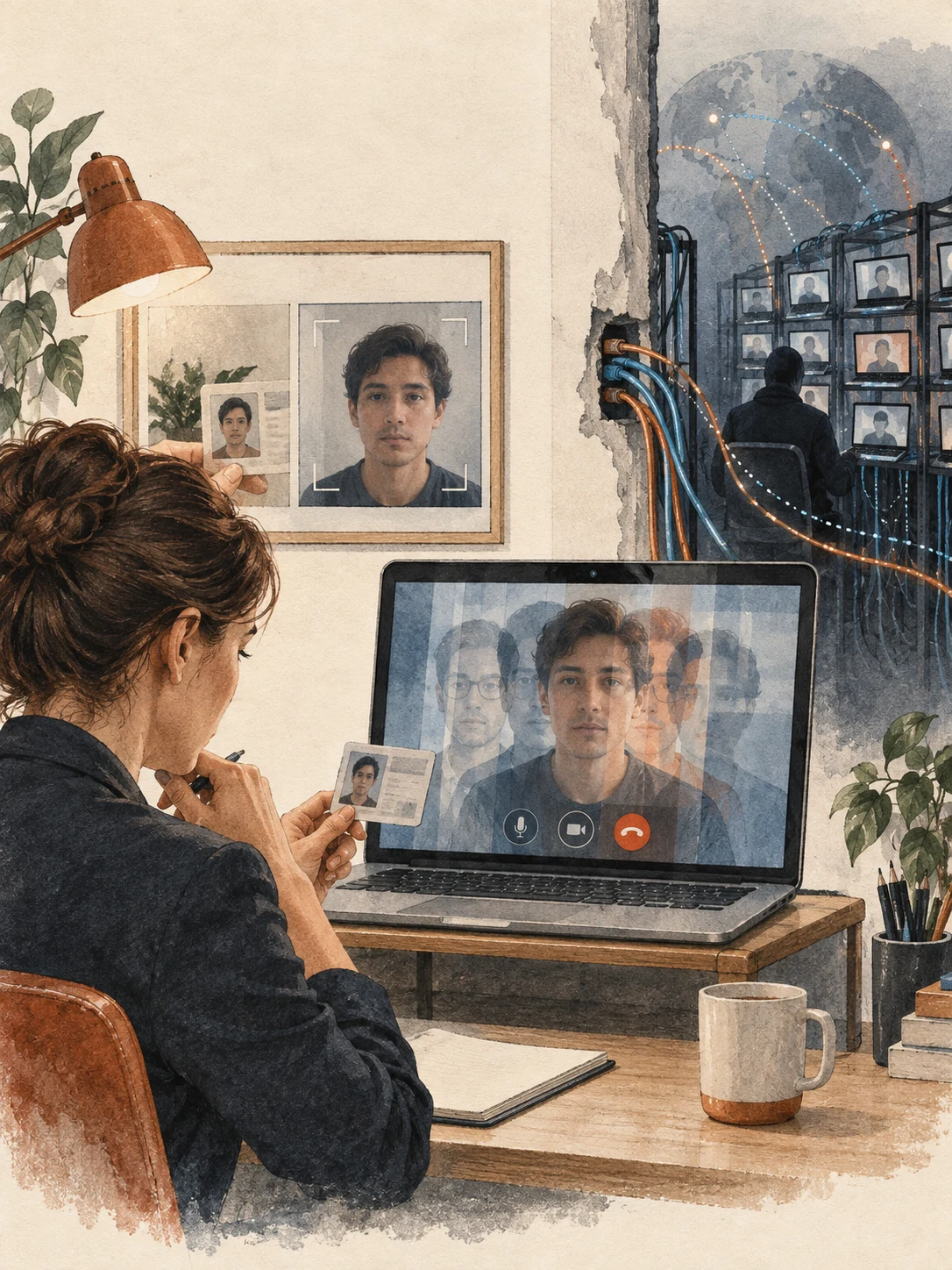
On April 15, 2026, the U.S. Department of Justice announced prison sentences for two Americans who helped North Korean remote IT workers use stolen identities and laptop farms. The scheme reached more than 100 U.S. companies, used the identities of at least 80 U.S. persons and generated more than $5 million for the DPRK. It is the sharpest version of the fake remote job candidates problem.
How did the laptop farm work?
Company laptops were shipped to U.S. homes and businesses, then connected to remote-control equipment. Overseas workers appeared to log in from America under another person's identity. The physical laptop passed the location sniff test while the human behind it was somewhere else.
What should continuous identity verification check?
Verify the same person at application, interview, onboarding and meaningful account changes. Confirm identity, work authorisation, device custody and payment details through documented checks. Then test the work separately.
The recruitment lesson
Security should be consistent, not intuitive. Accent policing, nationality guessing and “something felt off” are unreliable and discriminatory. Good controls protect legitimate remote candidates because everybody passes through the same clear process.
The lesson connects to identity and accountability in AI interviews and to any honest measure of AI hiring quality. I have spent nearly a decade in hiring. Verify identity. Evaluate capability. Do not let one pretend to answer the other.
On April 15, 2026, the U.S. Department of Justice announced prison sentences for two Americans who helped North Korean remote IT workers use stolen identities and laptop farms. The scheme reached more than 100 U.S. companies, used the identities of at least 80 U.S. persons and generated more than $5 million for the DPRK. It is the sharpest version of the fake remote job candidates problem.
The two defendants received sentences of 108 and 92 months. The Justice Department said the campaign caused at least $3 million in damage to employers and reached companies including Fortune 500 firms and a defence contractor.
How did the remote worker scheme operate?
The workers applied under stolen or borrowed U.S. identities. Company-issued laptops were sent to locations in the United States controlled by facilitators. Those machines were connected to keyboard, video and mouse equipment or remote-access software so a person overseas could work through them.
That arrangement solved two problems for the fraudster. The employer saw a U.S. mailing address, and network activity appeared to originate from a domestic device. A laptop sitting in the right country became a stage prop for the wrong identity.
According to the Justice Department, the workers gained access to company networks and sensitive information, including source code and export-controlled data. Salary payments were moved through U.S. accounts and shell companies.
Why is hiring verification only the first checkpoint?
A careful interview can still be followed by a different person logging in after onboarding. An authentic identity document can be presented by someone who does not control the account. A real U.S. resident can knowingly or unknowingly lend their address, bank details or identity.
That is why the FBI recommends identity verification during hiring, onboarding and throughout employment. The process should recheck high-risk changes such as a new device, unusual access location, payment update or request for remote-control software.
What should a fair verification process include?
- Consistent identity checks: Apply the same documented standard to comparable remote roles.
- Live verification: Match the person, approved identity evidence and interview participant through a secure process.
- Device custody: Confirm where company hardware is delivered, activated and operated.
- Access monitoring: Investigate impossible travel, persistent remote-control tools and unusual network behaviour.
- Change controls: Reverify sensitive updates to identity, payment, device or location.
- Candidate recourse: Provide a human path to correct a false mismatch or inaccessible verification step.
What should employers avoid?
Do not turn the case into a licence for accent policing, nationality guessing or suspicion of every contractor outside headquarters. Those shortcuts are unfair and operationally weak. A fraudster can rehearse an accent. A legitimate candidate can have an unstable connection, use accessibility tools or live somewhere different from where a recruiter expects.
Process beats intuition. Verify identity with purpose-built controls. Evaluate competence with role-relevant work. Review anomalies with evidence. Keep a route for correction. The point is to identify a mismatch, not to reward the interviewer with the most vivid hunch.
The recruitment lesson
I have spent nearly a decade in hiring and talent acquisition. Identity and ability are different questions. A person can be exactly who they claim and still fail the technical assessment. Another can produce excellent work while using a stolen identity. One check cannot substitute for the other.
The same separation is useful in AI interviews, where a clean score should not erase questions about who participated or how the answer was produced. It also belongs inside the definition of AI hiring quality. A placement is not high quality if the employer cannot establish who actually has access to the systems.
Verify identity. Evaluate capability. Monitor access. Do all three in a way a legitimate candidate can understand and complete.