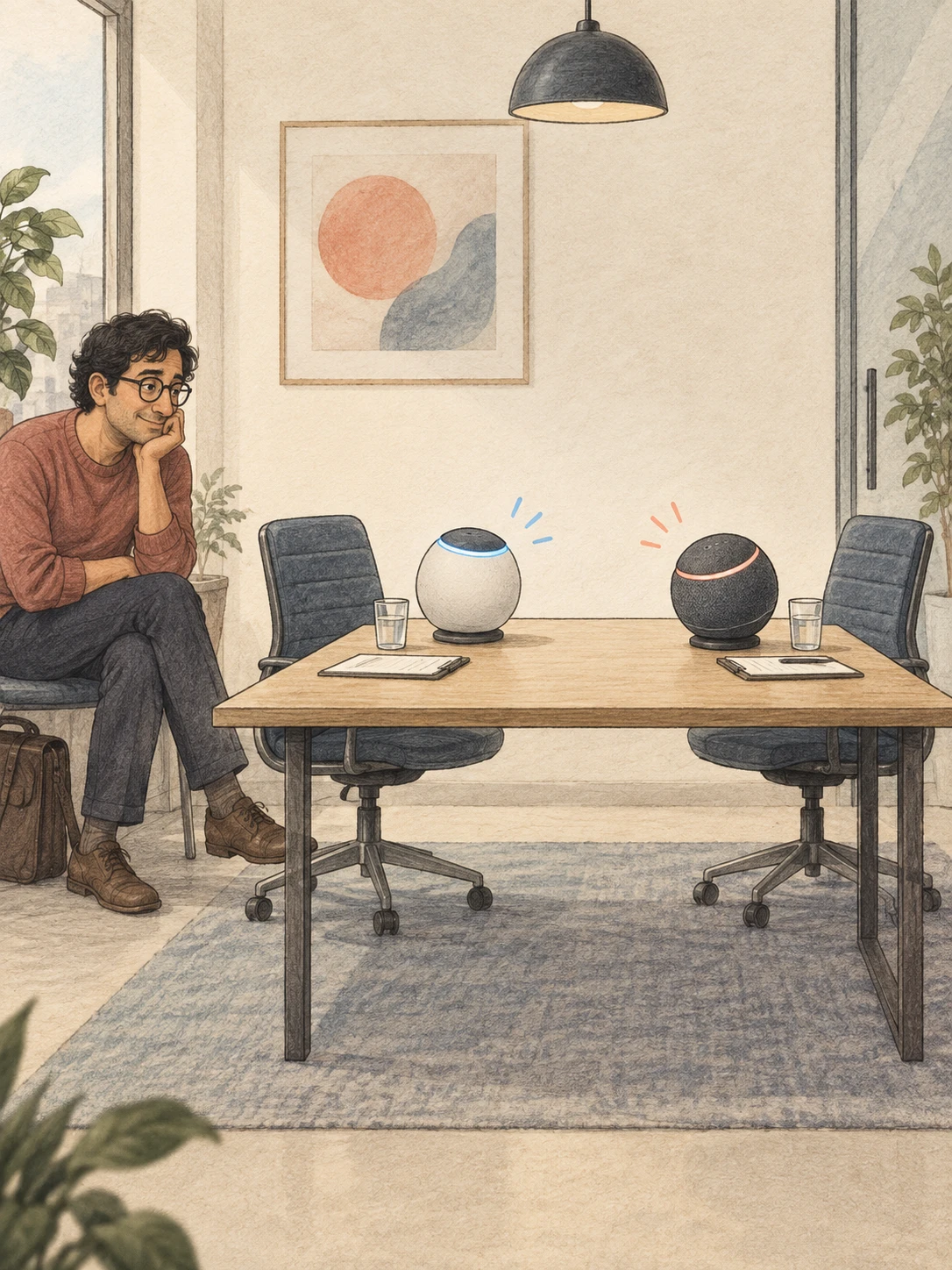
Christopher had applied to roughly 700 jobs. Five of them routed him to Riley, an AI recruiter for Everforth Apex Systems. After four automated interviews without a single human follow-up he tried something wonderfully absurd: he gave ChatGPT Voice the fifth interview. The bots completed a 10 minute call. Riley closed politely. A human recruiter still never appeared.
This may be the funniest example of AI job interviews in 2026. It's also a fairly clear picture of what happens when hiring automation removes reciprocity from recruitment. If a company sends a bot to collect a candidate's story and then offers no answer or accountable human the candidate eventually learns the same lesson: send a bot back.
🤖 🤝 🤖
The technology worked The relationship didn't
Riley asked questions and ChatGPT answered them. The call started and finished exactly as designed. If the only metric was whether an interview happened this might look like success. That's the trap. Recruitment isn't a content-extraction exercise. A candidate gives time, context, hope and often private information. The company owes something in return even if that something is a prompt rejection.
Are AI job interviews actually bad?
Not automatically. A 2026 field experiment involving 70,000 applicants found that people interviewed by AI voice agents were 12 percent more likely to receive job offers. Human recruiters still reviewed the interviews and made the decisions. That's a serious result. A patient and consistent interviewer can give more people a fair chance to explain themselves.
Zapier's pilot found faster screening, five times more candidates screened per role and a 4.5 out of 5 candidate rating. Candidates knew they were speaking to AI and could opt out without penalty. A recruiter reviewed every result. The technology handled the repetition but it wasn't allowed to make the hiring decision.
The recruitment lesson
AI can collect information and return hours to a recruiter. It can make questions more consistent and give more candidates a chance to be heard. It shouldn't erase accountability or turn ghosting into infrastructure.
I've spent nearly a decade in hiring and talent acquisition. The best recruitment tools make a conversation more human. They don't make the human optional. That's why the earlier U.S. Army GTA VI recruitment idea worked: somebody paid attention to what real people valued. The bot-on-bot interview is the inverse. Everyone optimised the process until the person disappeared.
Use AI to remove admin. Keep a human available for consequence. Then measure whether the system improves quality of hire rather than speed alone, and watch how the reported U.S. Tech Force AI interview pilot turns that principle into public practice. Otherwise the next interview may go brilliantly and nobody will have attended it.
Ontario's new ghost job disclosure rules apply the same principle one step earlier: before collecting a candidate's time and information, say whether an existing vacancy is actually there.
Christopher had applied to roughly 700 jobs. Five of them routed him to Riley, an AI recruiter for Everforth Apex Systems. After four automated interviews without a single human follow-up he tried something wonderfully absurd: he gave ChatGPT Voice the fifth interview. The bots completed a 10 minute call. Riley closed politely. A human recruiter still never appeared.
This may be the funniest example of AI job interviews in 2026. It's also an unusually clear picture of what happens when hiring automation removes reciprocity from recruitment. If a company sends a bot to collect a candidate's story and then offers no answer, explanation or accountable human the candidate eventually learns the same lesson: send a bot back.
🤖 🤝 🤖
What happened in the bot-on-bot job interview?
WIRED reported that Christopher had repeatedly spoken with Riley about different roles. Each call covered normal screening questions and ended with the possibility that somebody from the company might contact him. Nobody did. By the fifth attempt he'd heard enough polite promises from a machine.
Christopher gave ChatGPT Voice a little background information and asked it to stand in for him. He placed the two voice agents beside each other and let them talk. They discussed his background, a possible start date and onboarding. The conversation became circular but it still ended with both agents behaving as if a useful professional exchange had occurred. Nothing happened after it.
Christopher later went further. He created a fictional dream candidate stuffed with qualifications from an open role and let ChatGPT speak to Riley again. That interview lasted 23 minutes. The imaginary applicant had an answer for everything. Still no recruiter. Everforth Apex Systems didn't respond to WIRED's request for comment.
The technology worked The relationship didn't
Riley asked questions and ChatGPT answered them. The call started and finished exactly as designed. If the only metric was whether the interview happened this might look like success. That's the trap. Recruitment isn't a content-extraction exercise. A candidate gives time, context, hope and often private information. The company owes something in return even if that something is a prompt rejection.
The bot-on-bot interview didn't fail because one side used AI. It failed because nobody appeared responsible for what happened next. The machinery completed its task while the actual relationship quietly vanished. Efficient? Technically. Recruitment? Not particularly.
Are AI job interviews actually bad?
Not automatically. A 2026 natural field experiment randomly assigned 70,000 applicants to interviews with human recruiters or AI voice agents. Human recruiters still reviewed the interviews and made the hiring decisions. Applicants interviewed by AI were 12 percent more likely to receive job offers with gains in job starts and retention and no decline in worker productivity.
The researchers attributed the improvement to more structured and consistent information collection. That's a serious result. A patient and consistent interviewer can give more people a fair chance to explain themselves. The essential sentence is this: humans still made the decision.
What does responsible AI recruitment look like?
Zapier's 2026 pilot offers a useful contrast. It tested AI-led recruiter screens across roughly 250 interviews but candidates were told what the system was doing and could opt out without penalty. A recruiter reviewed every transcript, summary and score. The AI wasn't allowed to make the hiring decision.
Zapier reported that the time from initial review to completed screen fell from eight days to 2.75 days. Recruiters screened five times more candidates per role and candidates rated the experience 4.5 out of 5. The completion rate was 97 percent. Those results didn't come from pretending the human could disappear. They came from deciding where human judgment mattered most.
The actual recruitment lesson
AI can collect information and return hours to recruiters. It can standardise questions and expand access across time zones. It shouldn't erase accountability or turn ghosting into infrastructure.
- Tell candidates when they're speaking to AI.
- Give them a human or non-AI alternative.
- Name the person responsible for the next decision.
- Set a response deadline and close every loop.
- Use saved time to speak with more people, not to ghost them at greater scale.
I've spent nearly a decade in hiring and talent acquisition. The best recruitment tools make a conversation more human. They don't make the human optional. That's the bit every shiny automation demo tends to leave until the final slide.
That's why I liked the earlier story about the U.S. Army connecting reenlistment leave to GTA VI. It worked because somebody paid attention to what real people valued. The bot-on-bot interview is the inverse. Everyone optimised the process until the person disappeared.
We've seen the same dynamic in media where cheap packaging can outrun expensive reporting. Hiring now risks the same fate. The application is easier to generate and the screening is easier to automate. Trust becomes the scarce and expensive part.
Use AI to remove admin. Keep a human available for consequence. Otherwise the next interview may go brilliantly and nobody will have attended it.
(╥﹏╥)